

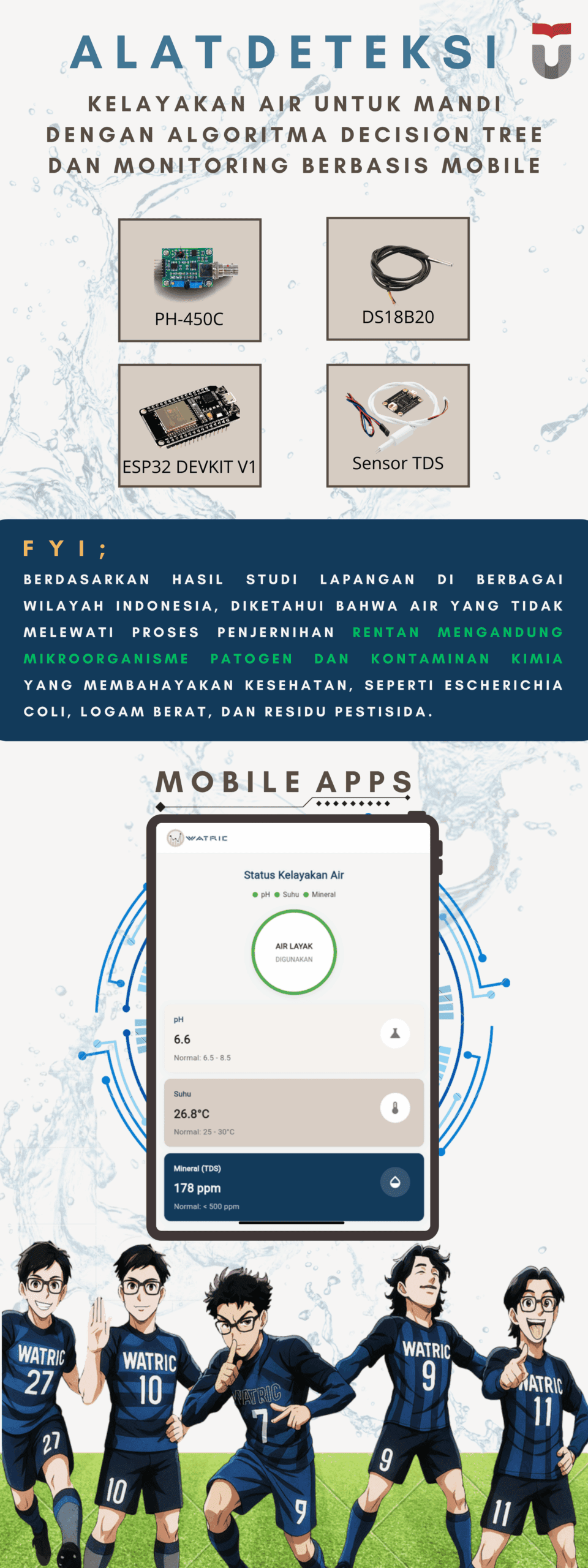
Overview of the Water Feasibility Detection Tool
This water feasibility detection tool is designed to measure the quality of water used for bathing using PH-450C, DS18B20, and TDS sensors, and is supported by the Decision Tree algorithm for automatic decision-making. This project also integrates a mobile application that allows users to monitor the water quality status in real-time, providing clear information regarding the pH, temperature, and mineral content in the water.
Reason for creating this tool
Based on the results of field studies in various regions of Indonesia, it is known that water that has not undergone purification processes is susceptible to containing pathogenic microorganisms and chemical contaminants dangerous to health, such as Escherichia coli, heavy metals, and pesticide residues. Therefore, a tool is needed that can help the public quickly and accurately check water feasibility.
How the System Works
This tool collects data from various sensors to measure water quality, and then the data is processed using the Decision Tree algorithm to determine whether the water is safe to use. The analysis results are displayed in the WATRIC mobile application, showing the pH value, temperature, and mineral content (TDS) of the water, with an indicator of whether the water is safe or unsafe to use.
Key System Features
- PH-450C Sensor Measures the acidity level of water (pH), which is crucial for determining water quality and whether the water is safe for use.
- DS18B20 Sensor Measures water temperature, which also affects the feasibility of bathing water.
- TDS Sensor Measures total dissolved solids (TDS), which indicates the concentration of minerals in the water.
- Decision Tree Algorithm Analyzes results from various sensors to determine whether the water is safe to use based on predetermined criteria.
- Mobile Monitoring The WATRIC application provides a visual display of the water quality status directly on mobile devices, allowing users to easily monitor water quality.
This project was developed by students of class S1IF-10-07, Informatics, Telkom University Purwokerto:
Riftian Dimas Adriano, Muhammad Faiz Arkan Herwanto, Andra Kubaik Achmad, Marchell Nova Aura, and Muhammad Fikri Fauzi.