

Overview of PEKAMAS
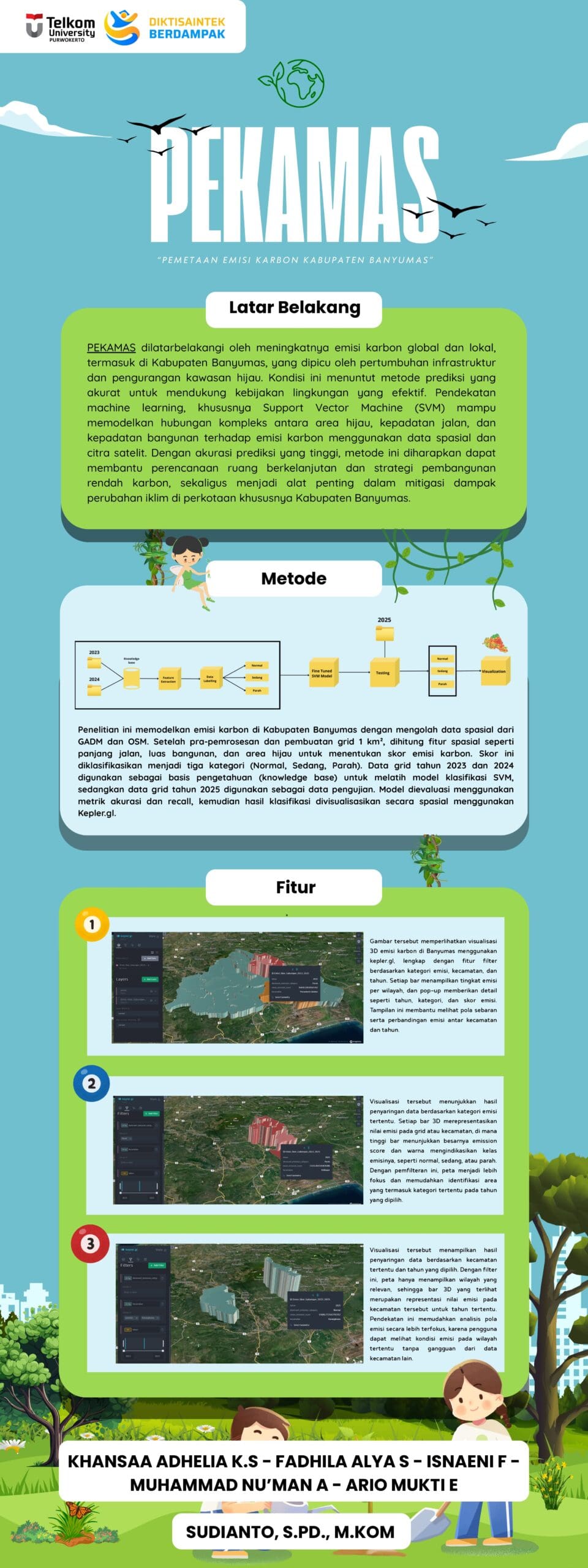
PEKAMAS is a website project created as part of a Capstone Project to map carbon emissions in Banyumas Regency. This project stems from the increasing global and local carbon emissions triggered by infrastructure growth and the reduction of green areas. To support more precise spatial planning and environmental policies, PEKAMAS utilizes a machine learning approach, specifically the Support Vector Machine (SVM) method, by processing spatial data and satellite imagery.
Brief background
PEKAMAS is designed as a tool capable of modeling the relationship between spatial variables such as green density, road density, and building density, and carbon emission conditions. This approach is expected to help mitigate the impact of climate change in urban areas, especially Banyumas, through mapping results that are more measurable and easy to understand.
Method used
The research models Banyumas carbon emissions by processing spatial data from GADM and OSM, then processing and creating 1 km grid-sized images. The data is labeled based on emission values (low to high) and classified into Normal, Medium, and Severe categories. Datasets from 2023 and 2024 are used as a knowledge base to train the SVM classification model, while the 2025 grid is used as test data. Evaluation is performed using accuracy and recall metrics, and the classification results are then spatially visualized using Kepler.gl.
Main system features
PEKAMAS displays grid-based map visualization that makes it easy for users to see the distribution of carbon emissions in Banyumas. The system provides filters to display data based on emission category, sub-district, and year, allowing users to compare conditions between regions and read emission patterns with greater focus. Users can also view details of specific points/grids to understand emission information in the selected area.
The PEKAMAS project was developed by students of class S1IF-10-07, Bachelor of Informatics, Telkom University Purwokerto, namely Khansaa Adhelia K.S., Fadhila Alya S., Isnaeni F., Muhammad Nu’man A., and Ario Mukti E.